 Add to Chrome
 Add to Firefox
 Add to Edge
ATLAS: All-round Testing of Long-context Abilities across Scales
May 27, 2026
Long-context language models now advertise context windows up to millions of tokens, yet evaluations typically report a single length or a narrow task family, masking two failure modes: performance can collapse as length grows, and strong retrieval need not transfer to downstream use. We present ATLAS, a benchmarking framework that redefines long-context evaluation as length-dependent capability profiling. ATLAS contributes three methodological principles:(i) a layered taxonomy separating foundational operations from application workloads so failures can be attributed, (ii) length-aware AUC scoring that integrates score-length curves over a fixed 8K-1M grid, replacing single-point metrics with full degradation profiles, and (iii) ATLAScore, a harmonic-mean aggregate over taxonomy categories that penalizes imbalanced profiles, with end-to-end uncertainty propagation from subset scores through the nonlinear final aggregate. We instantiate the framework across eight capability dimensions with nine auditable components and 6,438 instances, and evaluate 26 models. Gemini-3.1-Pro-Preview leads at 128K, Claude-Opus-4.6 leads at 1M. Rankings reshuffle substantially between ATLASscore@8K-128K and ATLASscore@8K-1M: 7 models move by at least two ranks, and the two taxonomy layers share only 61% of cross-model variance, with individual rank gaps up to 12 positions. These results support reporting long-context quality by capability and length, not by a single headline score.

AsyncTLS: Efficient Generative LLM Inference with Asynchronous Two-level Sparse Attention
Apr 09, 2026Long-context inference in LLMs faces the dual challenges of quadratic attention complexity and prohibitive KV cache memory. While token-level sparse attention offers superior accuracy, its indexing overhead is costly; block-level methods improve efficiency but sacrifice precision. We propose AsyncTLS, a hierarchical sparse attention system that combines coarse-grained block filtering with fine-grained token selection to balance accuracy and efficiency, coupled with an asynchronous offloading engine that overlaps KV cache transfers with computation via temporal locality exploitation. Evaluated on Qwen3 and GLM-4.7-Flash across GQA, and MLA architectures, AsyncTLS achieves accuracy comparable to full attention while delivering 1.2x - 10.0x operator speedups and 1.3x - 4.7x end-to-end throughput improvements on 48k - 96k contexts.
SPM: Structured Pretraining and Matching Architectures for Relevance Modeling in Meituan Search
Aug 27, 2023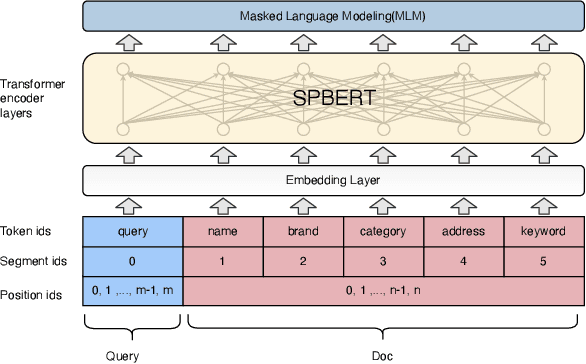
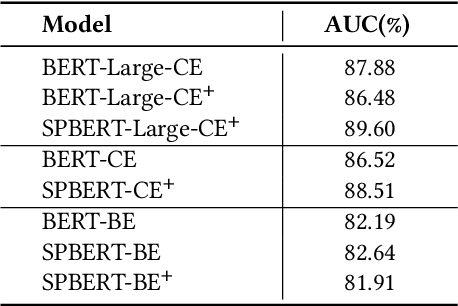
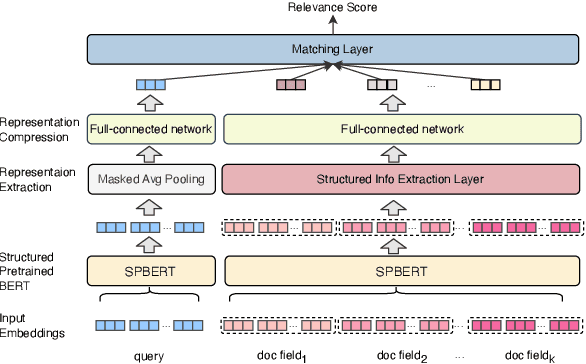
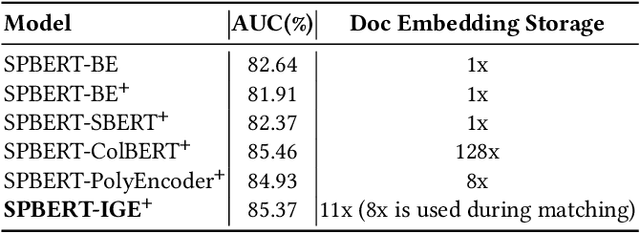
In e-commerce search, relevance between query and documents is an essential requirement for satisfying user experience. Different from traditional e-commerce platforms that offer products, users search on life service platforms such as Meituan mainly for product providers, which usually have abundant structured information, e.g. name, address, category, thousands of products. Modeling search relevance with these rich structured contents is challenging due to the following issues: (1) there is language distribution discrepancy among different fields of structured document, making it difficult to directly adopt off-the-shelf pretrained language model based methods like BERT. (2) different fields usually have different importance and their length vary greatly, making it difficult to extract document information helpful for relevance matching. To tackle these issues, in this paper we propose a novel two-stage pretraining and matching architecture for relevance matching with rich structured documents. At pretraining stage, we propose an effective pretraining method that employs both query and multiple fields of document as inputs, including an effective information compression method for lengthy fields. At relevance matching stage, a novel matching method is proposed by leveraging domain knowledge in search query to generate more effective document representations for relevance scoring. Extensive offline experiments and online A/B tests on millions of users verify that the proposed architectures effectively improve the performance of relevance modeling. The model has already been deployed online, serving the search traffic of Meituan for over a year.